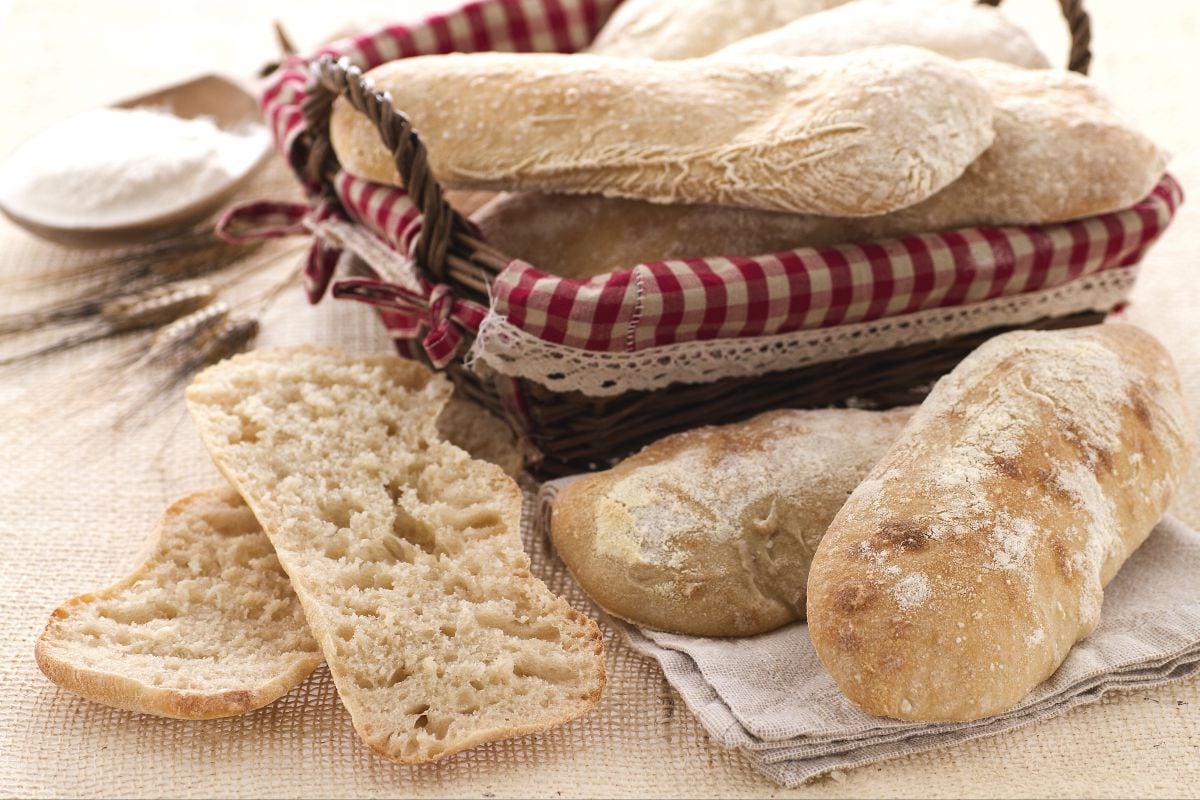
Ciabatta is a type of elongated bread, originating from the Veneto region, with a hydrated dough that, after baking, presents a perfect texture.
Ingredients
Instructions
To prepare the ciabatta, start by kneading the poolish, a highly hydrated pre-ferment: dissolve the dry yeast in the water (alternatively, you can use 0.21 oz of fresh yeast) 1 ; in a bowl, mix the two sifted flours 2 , the all-purpose and the bread flour, then combine everything by pouring the liquid slowly over the flours 3 .
Mix well with a wooden spoon 4 until you obtain a homogeneous, smooth, and very soft dough 5 . Cover the dough with plastic wrap and let it rise for about 3 hours at room temperature. After three hours, the poolish will appear more swollen, full of bubbles, and slightly darker in color 6 .
You can now proceed with the second dough: dissolve the dry yeast (alternatively, you can use 0.32 oz of fresh yeast) and the malt (alternatively, you can use sugar) in the water (7-8), mix the sifted flours together and pour the poolish into the bowl of a stand mixer, equipped with the paddle attachment 9 . If you don't have one, you can knead in a bowl, first using a spoon and then, once all the ingredients are gathered, continue by hand.
While the stand mixer is running at medium speed, add both the liquid and the flours alternately (10-11), until they are all used up. When all the ingredients are gathered around the paddle, clean it and replace it with the dough hook. Continue kneading for 5 minutes, add the salt 12 and continue for another 5-7 minutes, until the dough wraps around the hook.
At that point, detach it and transfer it to a bowl (or leave it directly in the bowl used), cover it with plastic wrap and let it rest for 1 hour at room temperature, ideally between 75°F and 77°F 13 . After this time, turn the dough onto a work surface dusted with plenty of semolina flour 14 . Also, dust the surface with semolina 15 and
proceed by making the folds necessary for proving: bring the dough forward 16 , then fold the lower part over the upper part 17 and then fold from one side 18 and
the other 19 . Slightly flatten the dough 20 and divide it into about 10 pieces, each weighing approximately 5-5.5 oz 21 .
Let the dough balls rise on a well-floured surface with semolina, making sure to place them with the cut side up 22 . Sprinkle them with semolina flour, cover them with plastic wrap to prevent the dough surface from drying out 23 , and leave them for at least 1 to 1.5 hours in a warm environment (about 80°F). After this time, the dough balls will double in size 24 .
Now take one dough ball at a time, flip it over 25 , and immediately transfer it to a preheated baking sheet in the oven covered with baking paper 26 . Stretch the dough gently, pulling it delicately, to prevent the gases from escaping 27 .
and bake them in a preheated static oven at 465-482°F (if fan-assisted, 428-446°F) 28 : before closing the oven, spray 5-6 times with water using a spray bottle to create a warm and humid environment, which will prevent the crust from forming immediately and develop the crumb instead. Baking is the most delicate phase: for the first 8 minutes, the ciabatta should bake at 240-250°C. After the first 8 minutes, lower the temperature to 392°F (if fan-assisted, 356°F) and bake for another 8 minutes. Continue baking for the last 3-4 minutes, keeping the oven ajar with a wooden spoon wedged in the opening to create a vent, allowing the excess steam to escape, so as to promote the final baking of the crust and achieve a crispy texture. Finally, let your ciabatta cool 30 and they're ready to be devoured!
Nutrition
- Calories
- 196 kcal
- Carbohydrate Content
- 40.8 g
- Sugar Content
- 1 g
- Fat Content
- 0.5 g
- Saturated Fat Content
- 0.11 g
- Fiber Content
- 1.5 g
- Cholesterol Content
- 0 g
- Sodium Content
- 500 g