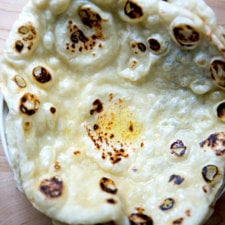
How To Make Fresh Homemade Ciabatta Bread
fromalexandracooks.comalexandracooks.com/2021/06/26/how-to-make-ciabatta-bread
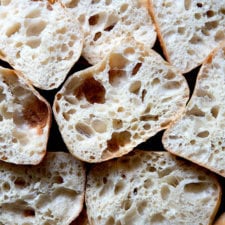
This post will teach you how to make a crusty, open-crumbed loaf of ciabatta bread. Below you will find a detailed guide full of tips and tricks to help you make a loaf of ciabatta bread with a crisp, golden exterior and a light, airy crumb. Find video guidance below, too. Notes: As always, for best results, use a digital scale to measure the flour. I find a bench scraper particularly helpful for this recipe. I also really love using a straight-sided vessel (with lid) both for letting the dough rise and storing it in the fridge. Water: This is a very high-hydration dough, and depending on the flour you are using and your environment (if you live in a humid environment, for instance), you may need to reduce the amount of water. If, for example, when doing your stretches and folds, the dough never came together in a cohesive ball, I would reduce the water by 50 to 60 grams next time around. Flour: I have had success using all-purpose flour, but if you can get your hands on bread flour (I use King Arthur Flour Bread Flour, which is 12.7% protein), that is ideal. All flours absorb water differently. Through troubleshooting with people all over the world, I have learned that the type of flour being used plays a critical role in how the dough turns out, and often the amount of water needs to be reduced, especially if you live in Canada or abroad. You can make the recipe once as written or add the water slowly, mixing as you do, until the dough resembles the dough in the video. Tunneling: A common problem with ciabatta is tunneling: large gaping holes running through a loaf of bread. If you end up baking a loaf of hollow ciabatta, try lengthening the final proof. Why? Because when under-proofed dough enters an oven, the remaining energy in the yeast leads to fast and furious gas production. This explosion of gas breaks the gluten structure of the bread, causing the tunnel to form.
Ingredients
Instructions
In a large bowl, whisk together the 50 grams flour and the 2 grams (1/2 teaspoon) instant yeast. Add 50 grams water and stir with a spatula until combined. Cover the bowl with a tea towel or cloth bowl cover and set aside for 3 to 4 hours or until the dough’s surface is dimpled with holes.
To the bowl of the poolish, add the water. The sponge should release from the bowl and parts of it, if not all of it, will float. Add the salt and stir briefly. Add the flour, and stir until you have a wet, sticky dough ball — dough will be very sticky. Cover with a tea towel or cloth bowl cover and let sit for 30 minutes.
: With wet hands, grab one side of the dough, and pull up and to the center. Rotate the bowl a quarter turn, and repeat the grabbing and pulling. Do this until you’ve made a full circle. (Watch the video for more guidance. I employ a “slap-and-fold” technique, which is helpful when handling these wet doughs.) Cover the bowl. If time permits, repeat this process three more times at 30-minute intervals for a total of 4 sets of stretches and folds over the course of two hours. If you are short on time, know that doing just one or two sets of stretches and folds is totally fine.
Transfer the dough to a straight-sided vessel, if you have one, or leave it in the bowl if you don’t. Cover the vessel with a towel and let rise until doubled in volume. Punch down (deflate) the dough — if your dough is still in the bowl, you can deflate it using wet hands right in the bowl; if your dough is in a straight-sided vessel, it may be easier to turn the dough out onto a work surface and ball it up using wet hands to prevent sticking. Return the dough to the vessel, cover it with an airtight lid, and transfer it to the refrigerator immediately for at least 12 hours. The dough can remain in the fridge for as long as 48 hours.
Portion, shape, and proof: For Ciabatta Loaves: Turn the dough out onto a work surface. I prefer to do this step without flour, but absolutely sprinkle your surface lightly with flour as needed to make the dough manageable to work with. Using a bench scraper or your hands, shape the dough into a tight ball; then use the bench scraper to divide the dough in half. If you want perfectly even balls, each portion will way roughly 455 grams. Again, use the bench scraper or your hands to ball up each portion into a tight ball — see video for guidance. Sprinkle your countertop liberally with flour. Place the balls top-side (smooth side) down onto the flour. The seam-side will be on top now, and it may split open — this is fine. Sprinkle the top surface of the balls liberally with flour. Cover with a tea towel and let rest for 2.5 hours.
Sprinkle a work surface with flour. Turn the dough out onto the work surface, sprinkle the dough with more flour, and pat it into a rectangle. Using a bench scraper, divide into 8 portions. Transfer each portion to a parchment-lined sheet pan, cover with a tea towel, and let stand for 2.5 hours.
After the dough has proofed for 2 hours, heat the oven to 425ºF.
Bake: For Ciabatta Loaves: When the dough has finished proofing, gently flip each ball over — I find a bench scraper to be helpful here. Then use both hands to stretch each ball out gently into a rectangular shaped “slipper”. Transfer to a parchment-lined sheet pan. Transfer the pan to the oven and bake for 20 – 25 minutes or until the loaves are golden all around.
For Ciabatta Rolls: Remove the towel, transfer the pan to the oven, and bake for 20 – 25 minutes, or until the loaves are golden all around.
="instruction-step-10" style="font-weight: 400">
Cool: Remove pan from oven. Transfer ciabatta rolls to a cooling rack. Let cool for 20 to 30 minutes before slicing.